
Conveyor vs. Flash Dryers for DTF Powder Curing
Compare conveyor and flash dryers for DTF powder curing. Learn how to improve output consistency, reduce defects, and scale your production efficiently.
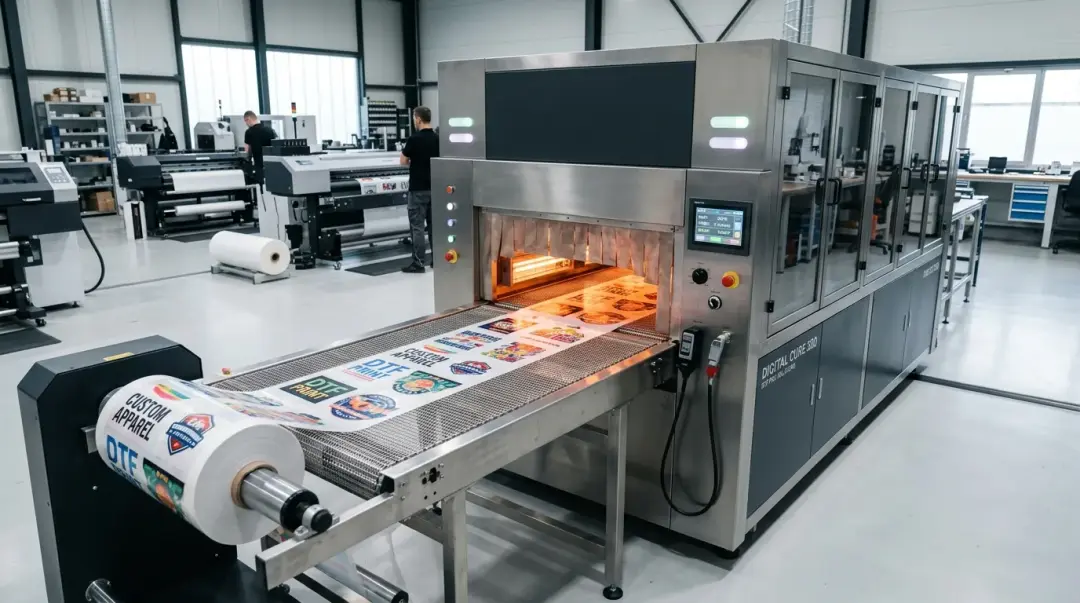
Curing the hot-melt adhesive powder is arguably the most critical step in the Direct to Film (DTF) workflow. It is this chemical bond, formed through precise heat application, that determines the long-term wash durability and elasticity of your transfers. Many beginners start with manual curing methods like flash dryers—equipment often repurposed from screen printing workflows. However, as production demands grow, the limitations of these manual methods become apparent.
The Role of Curing in DTF Durability
DTF curing requires the thermoplastic adhesive powder to melt and bond with the printed ink layer without degrading the film substrate. Failure in this process generally manifests in two ways:
- Under-curing: The powder melts but fails to fully flow and bond with the ink. This results in a brittle, crystalline surface that loses adhesion after only a few wash cycles.
- Over-curing: Excessive or uneven heat can scorch the powder, degrade the film, or cause the substrate to warp, leading to cracked, low-quality transfers.
Flash Dryers: The Entry-Level Standard
Flash dryers are compact, infrared units that provide a quick burst of intense heat. While they are cost-effective for low-volume testing, they rely entirely on the operator to maintain precise distance control and consistent dwell time.
At volumes below 20–30 prints per session, a flash dryer can be manageable. However, as volume increases, operator fatigue and natural human inconsistency lead to significant variance in cure quality. Every print requires manual oversight to ensure it hasn't been exposed to too much or too little heat.
Conveyor Dryers: Scaling for Consistency
Conveyor curing ovens transition the process from manual to automated. By moving the film through a calibrated heat tunnel at a fixed belt speed, these units ensure that every print receives the exact same heat exposure for the same duration. This eliminates the variables of operator fatigue and attention lapses, which are the primary drivers of inconsistent output.
Key Comparison: Conveyor vs. Flash
| Feature | Flash Dryer | Conveyor Dryer |
|---|---|---|
| Operation | Manual (requires constant attention) | Automated (fixed speed/heat) |
| Consistency | High variance | High consistency |
| Production Capacity | Low (up to 20-30/session) | High (40-50+/day) |
| Defect Rates | Higher due to human error | Lower (60-80% reduction) |
ROI and Production Strategy
Investing in a conveyor oven is often the single most effective way to reduce waste. Entry-level units (16–24 inches wide) typically range from $800 to $1,200. While this is a significant jump from a simple flash unit, the math favors the upgrade once you cross the threshold of 40–50 prints per day.
Key Takeaway: Transitioning to a conveyor oven can reduce curing-related reprint rates by 60–80%. At moderate volumes, the equipment cost is frequently recouped through saved materials and labor time within 30–60 days.
Recommended Workflow Transition
We recommend a phased approach to equipment scaling:
- Start with a Flash Dryer: Use this phase to validate your DTF designs and production process at low volumes.
- Upgrade to a Conveyor Oven: Budget for this upgrade as soon as you are consistently producing 30+ transfers per session.
- Maintain Redundancy: Keep your flash dryer after the upgrade. It serves as an excellent backup for small, urgent jobs or as a contingency if your conveyor oven requires maintenance.
By automating the curing process, you ensure that your business scales efficiently while maintaining the professional wash-fastness standards your customers expect. For further needs, please browse our DTF Supplies page — curing equipment or dryer section.
Frequently Asked Questions
What is the main difference between using a flash dryer and a conveyor oven for DTF powder curing?
How do I know if my DTF prints are under-cured or over-cured?
When is it the right time to upgrade from a flash dryer to a conveyor oven?
Should I get rid of my flash dryer after upgrading to a conveyor oven?
What is the visual indicator of a properly cured DTF transfer?
Comments
No comments yet. Be the first to share your thoughts!