
How to Build a DTF Quality Control System That Scales
Stop relying on manual checks. Learn how to build a scalable, three-point DTF quality control system to minimize reprints and maximize shop efficiency.
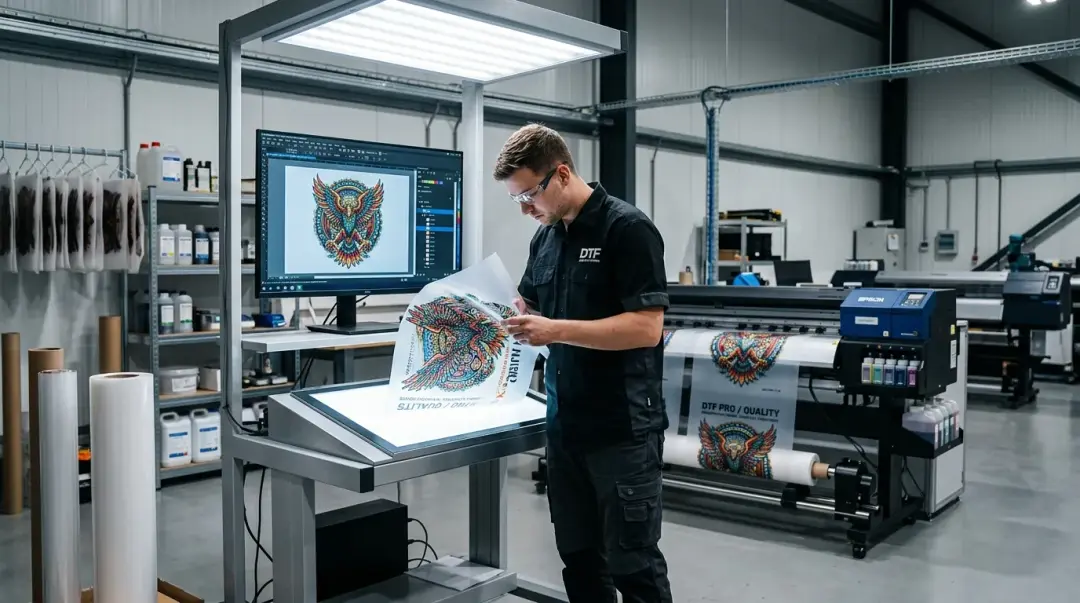
Scaling Your DTF Quality Control
Quality control in a DTF shop is straightforward when you are pressing 10 transfers a day. You can visually inspect every piece before it ships, catch errors, and fix them without significant overhead. However, when your volume hits 100+ orders per day across multiple operators and substrates, reliance on individual operator intuition becomes a liability. The failure cost of letting a defective product reach a customer—including shipping, reprints, and brand damage—is far higher than the cost of implementing a systematic QC framework.
To scale, you must transition from subjective, person-dependent checks to a standardized, three-point quality control system. This approach ensures that quality is consistent regardless of whether the operator is a veteran or a new hire.
The Three Pillars of DTF Quality Control
A scalable system creates inspection checkpoints at the lowest possible cost-per-failure point. The goal is to catch issues before they consume expensive film, ink, and labor.
1. Pre-Production: The File Integrity Check
Most DTF errors originate before the print head even moves. A robust pre-production check prevents bad files from entering the queue.
- Format: Ensure all files are high-resolution PNGs with transparent backgrounds.
- DPI Requirement: Maintain a minimum of 150 DPI at the final output size.
- Visual Inspection: Zoom to 100% to check for pixelation or compression artifacts.
- Specifications: Verify that dimensions match the order request and that text is legible.
Operational Impact: This 60–90 second check catches approximately 80% of preventable production errors.
2. In-Production: The Printing Session Validation
Equipment performance varies over time due to heat, humidity, and ink sedimentation. You must validate the printer’s health at the start of every shift and after any intervention.
- Nozzle Check: Always run a nozzle check pattern before initiating a print batch.
- Test Prints: Perform a short test print after head cleans, ink changes, or extended idle periods.
- Standardization: Do not rely on visual memory. Keep a reference printed guide of a perfect nozzle test pinned at the machine for immediate comparison.
3. Post-Press: The Final Verification
The final inspection ensures the output meets your brand standards before it reaches the customer's hands. Apply these four objective pass/fail criteria:
| Check Point | Pass Standard | Fail Action |
|---|---|---|
| Edge Integrity | No peeling or lifting of the powder/ink layer. | Reprint |
| Ghosting | Clear, sharp edges with no secondary image shadows. | Reprint |
| Color Accuracy | Matches reference file on a calibrated monitor. | Recalibrate/Reprint |
| Consistency | No banding or nozzle streaks in solid areas. | Reprint |
Implementing Scalable Standards
The secret to scaling is removing subjectivity. When an operator asks, "Does this look okay?" you have already failed at scale. Every team member should be equipped with a written checklist and visual aids representing both 'Pass' and 'Fail' conditions. By institutionalizing these checks, shops consistently report reprint rates dropping to 1–3% of total orders, regardless of volume.
Key Takeaway: Quality control is an investment in throughput. By catching failures at the cheapest possible point—rather than after shipping—you protect your margins and ensure reliable, professional output at scale.
Frequently Asked Questions
How can I reduce reprint rates as my DTF printing volume grows?
What are the essential pre-production checks for DTF files?
How should I validate printer health before starting a DTF print batch?
What criteria should be used for the final post-press inspection?
Why is it important to remove subjectivity from my DTF quality control process?
Comments
No comments yet. Be the first to share your thoughts!