
DTF Printer Ink Delivery System: Dampers, Lines & Care
Master your DTF printer's ink delivery system. Learn how to diagnose and maintain dampers, ink lines, and cartridges to prevent costly printhead failures.
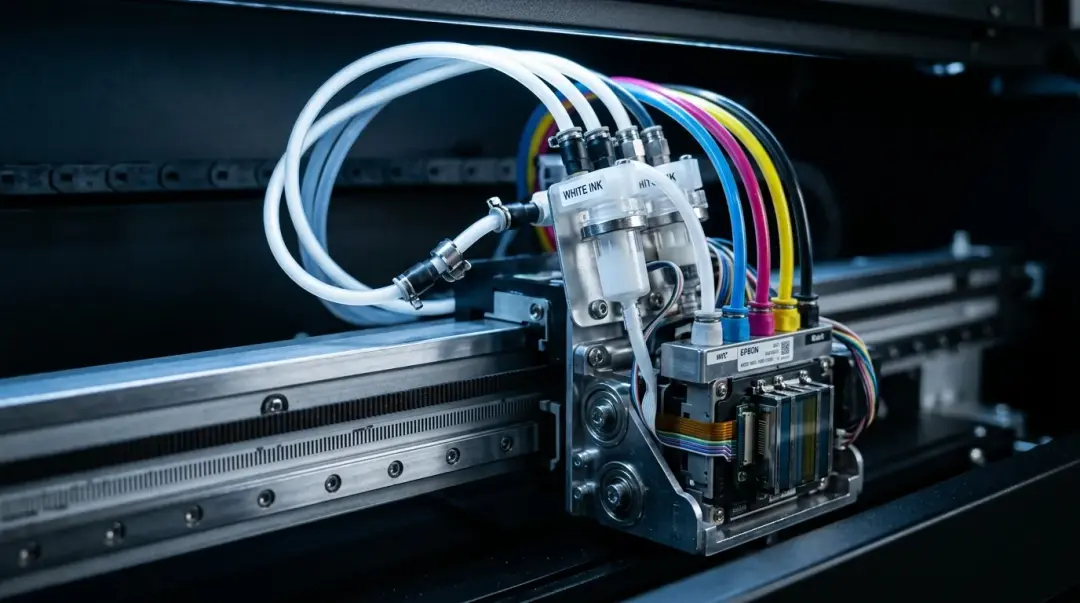
The Anatomy of Your DTF Printer's Ink Delivery System
Many DTF (Direct to Film) operators view the printing process as a simple path: ink leaves the cartridge and arrives at the nozzles. However, the complex network of ink lines, dampers, and connectors between these two points is where most reliability issues reside. Understanding this delivery system is the key to minimizing downtime and extending the lifespan of your expensive printheads.
What Are Dampers and Why Do They Fail?
Dampers are critical, small inline reservoirs positioned between the ink supply lines and the printhead. They serve two vital functions that keep your printer running smoothly:
- Pressure Stabilization: They act as a buffer that smooths out ink flow pressure variations caused by the rapid acceleration and deceleration of the printhead carriage.
- Filtration: Each damper contains a small, fine filter element designed to catch contaminants or sediment before they can block the microscopic nozzles of the printhead.
Identifying Damper Failure
When a damper fails, it often produces intermittent nozzle misfires that do not respond to standard head-cleaning cycles. Because the blockage or pressure issue is upstream of the printhead, cleaning the nozzles themselves provides only temporary relief—or none at all. Common signs of failure include:
- Air infiltration into the system.
- Particle accumulation causing starvation.
- The internal rubber membrane stiffening or losing elasticity due to age and chemical exposure.
Key Takeaway: Dampers typically require replacement every 6–12 months, depending on your production volume. At a cost of $5–$20 each, this is a minor maintenance expense compared to the high cost of a damaged printhead caused by ink starvation.
The Critical Role of Ink Tubing and Connectors
Equally important—and often more overlooked—is the flexible tubing that transports ink throughout the system. This tubing flexes thousands of times every day as the carriage traverses the print width. Over time, this mechanical stress leads to significant issues.
Inspection and Maintenance Checklist
Perform a visual inspection of all ink lines every 90 days. Focus on these three areas:
- Micro-cracks: These develop at high-flex points, particularly near the carriage connection where the bending radius is tightest. These cracks introduce air into the lines, causing bubbles that look exactly like printhead clogs.
- Discoloration: Changes in the appearance of the tubing can indicate ink-to-air oxidation, a telltale sign of an air leak.
- Kinking: Ensure the path is clear and that lines aren't being pinched by cable management systems.
White Ink Specifics
White ink is notoriously prone to settling because of its heavy titanium dioxide pigment. Partial translucency in your ink lines is an asset—use it. Visually monitor your white ink lines for pigment buildup on the tubing walls. If you see sediment collecting, a system flush is required immediately, even if your print quality remains acceptable, to prevent permanent blockages.
Maintenance Comparison Table
| Component | Inspection Interval | Action Required |
|---|---|---|
| Dampers | Monthly | Check for air bubbles; replace every 6-12 months. |
| Ink Tubing | Every 90 Days | Inspect for micro-cracks, leaks, or pigment buildup. |
| White Ink Lines | Weekly | Check for pigment settling; perform regular agitation. |
| Cartridges/Tanks | Daily | Ensure proper ink levels and air ventilation. |
Final Insights for DTF Operators
Your ink delivery system is the heartbeat of your DTF operation. By proactively inspecting dampers for signs of stiffening and checking tubing for the first signs of stress, you can prevent catastrophic printhead failure. Treat your DTF printer as a high-precision machine, and it will reward you with consistent, high-quality output.
Frequently Asked Questions
What function do dampers serve in a DTF printer's ink delivery system?
How can I tell if my DTF printer's dampers are failing?
How often should I replace the dampers on my DTF printer?
What should I look for when inspecting my DTF ink tubing?
Why does white DTF ink require special maintenance compared to CMYK inks?
Comments
No comments yet. Be the first to share your thoughts!