
DTF Transfers vs. Sublimation for Drinkware: Which is Best?
Choosing between sublimation and UV DTF for drinkware? Compare durability, substrate compatibility, and finish to find the right method for your shop.
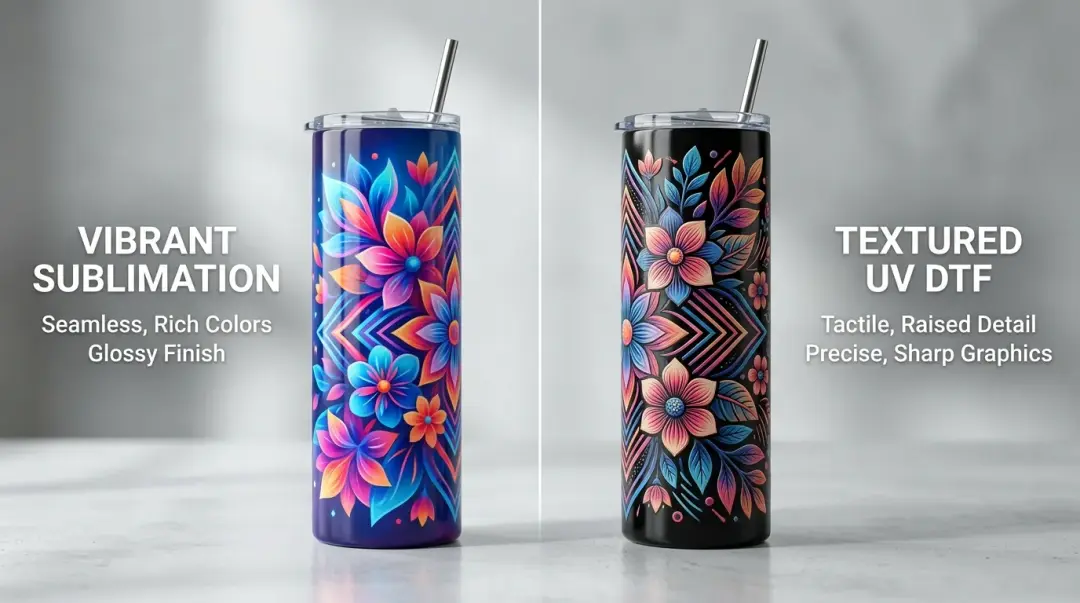
Expanding your custom apparel shop into hard goods often begins with drinkware. As you look to scale, the debate between sublimation and UV DTF (Direct to Film) becomes central. While both methods produce professional-looking tumblers, they operate on entirely different mechanical and chemical principles, making them suitable for different product lines and client needs.
Understanding the Core Technologies
Before deciding which method to implement, it is essential to define how each technology interacts with the substrate. Understanding these foundations will help you set client expectations regarding longevity and finish.
What is Sublimation?
Sublimation is a chemical process. When heat and pressure are applied, the sublimation ink converts from a solid state directly into a gas, permeating the specially formulated polyester coating of the drinkware. Upon cooling, the dye locks into the coating, creating a permanent, vibrant, and seamless design.
What is UV DTF?
UV DTF is a mechanical application. These are pre-printed transfers consisting of UV-curable ink on a film with a pressure-sensitive adhesive. The transfer is applied to the surface manually; the adhesive bonds the ink layer to the object. Unlike sublimation, no heat or special coating is required.
Sublimation: The Gold Standard for Durability
For premium retail drinkware, sublimation remains the industry leader. Because the design becomes part of the substrate rather than sitting on top, the results are remarkably resilient.
- Durability: Sublimated prints are fully dishwasher-safe and UV-resistant.
- Texture: The print is entirely flat, providing a smooth finish that feels like the original cup.
- Application: Requires specific sublimation-coated (polyester) blanks.
The Critical Limitation: Sublimation will not work on raw stainless steel, glass, or ceramic unless they feature a professional polyester receptor layer. Attempting to sublimate on an incompatible surface will result in a faded or completely non-existent image.
UV DTF: The Versatility Powerhouse
UV DTF wraps offer unparalleled flexibility, allowing you to decorate virtually any non-porous surface. If you are serving a market that demands custom designs on colored tumblers, glass, or acrylic, UV DTF Stickers by Size product page — drinkware or hard goods application section is the superior choice.
- Versatility: Compatible with powder-coated tumblers, raw metal, glass, and even wood.
- Ease of Use: No heat press, oven, or specialized chemical coatings are required.
- Speed: The application process is simple and has a very short learning curve.
Important Consideration: Because the ink sits on top of the surface, UV DTF has a slight texture and visible edges. While durable, these prints are generally not rated for long-term dishwasher use, as high heat can eventually compromise the adhesive layer.
Comparison Table: Sublimation vs. UV DTF
| Feature | Sublimation | UV DTF |
|---|---|---|
| Substrate | Polyester-coated only | Any smooth, non-porous surface |
| Texture | Zero texture (flat) | Slightly raised/tactile |
| Durability | Permanent/Dishwasher-safe | Hand-wash recommended |
| Equipment | Sublimation printer, press/oven | None (cold application) |
Key Takeaway: Choose sublimation for high-end retail products on white-coated blanks where dishwasher safety is required. Choose UV DTF for promotional merchandise, event giveaways, and creative applications where substrate versatility and ease of production are the priority.
Final Verdict for Custom Shops
Neither method is objectively "better"—they are simply built for different purposes. Many successful shops eventually offer both: sublimation for the premium, dishwasher-safe market and UV DTF for quick-turn, high-variety custom jobs that don't fit the standard white-blank profile. By aligning your technology choice with your product strategy, you can maximize both quality and operational efficiency.
Frequently Asked Questions
Can I use sublimation to print on plain stainless steel tumblers?
Are UV DTF prints dishwasher-safe?
What equipment is needed to apply UV DTF transfers?
How does the finish of a sublimation print differ from UV DTF?
Which method is better for customizing colored or raw metal tumblers?
Comments
No comments yet. Be the first to share your thoughts!