
DTF vs. POD: Why Transfers Beat Fulfillment for Shops
Stop losing margins to print-on-demand. Discover why transitioning from POD to DTF transfers is the key to scaling your custom apparel business profitably.
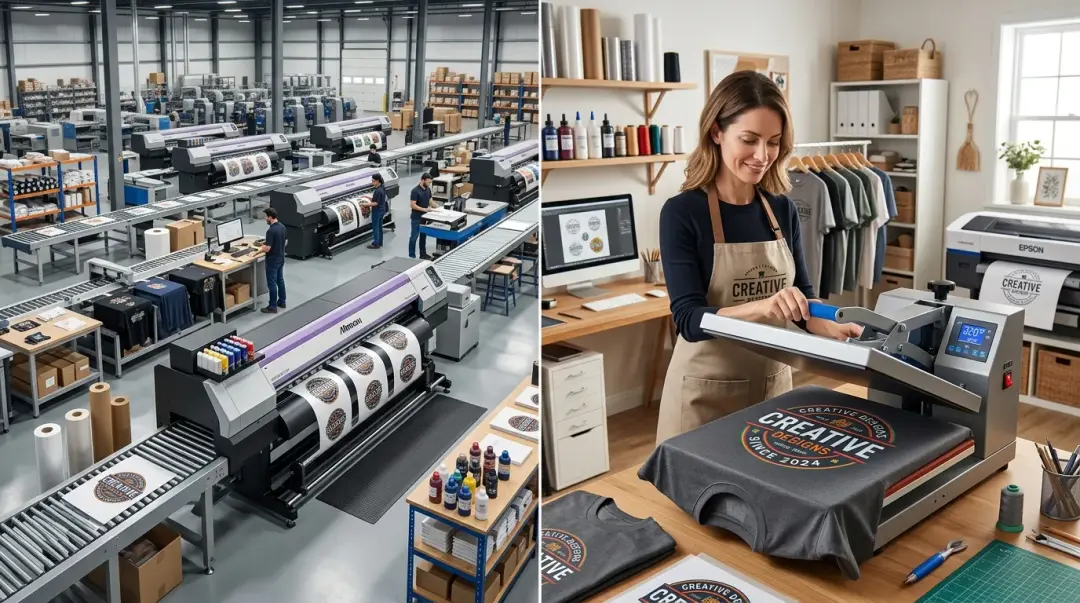
The Profitability Gap in Custom Apparel
For many emerging e-commerce entrepreneurs, print-on-demand (POD) platforms like Printful, Printify, and Gelato serve as an invaluable launchpad. These services eliminate the need for inventory management and production infrastructure, allowing sellers to list custom apparel effortlessly. However, as your shop grows, the hidden cost of this convenience becomes an existential threat to your business sustainability.
The reliance on third-party fulfillment creates a significant profitability gap. While you are busy scaling your brand, a large portion of your potential revenue is being siphoned off by fulfillment markups. Transitioning to a hybrid model using Direct-to-Film (DTF) transfers offers a proven path to reclaim those margins without sacrificing operational simplicity.
The Hidden Costs of POD Fulfillment
POD fulfillment models are built for low-risk entry, not long-term margin optimization. When you sell a standard t-shirt through a typical POD provider, you are paying for the garment, the printing process, picking, packing, and shipping logistics. All these steps carry an embedded markup.
| Metric | POD Fulfillment | In-House DTF Hybrid |
|---|---|---|
| Cost Per Unit | $15 – $28 | $4 – $8 |
| Margin Impact | High margin compression | High margin retention |
| Operational Effort | Zero (Hands-off) | Low (Heat press required) |
As illustrated above, the cost difference can reach $10–$20 per unit. For a business moving 200+ units per month, this represents a staggering $2,000–$4,000 in monthly margin left on the table—funds that could otherwise be reinvested into professional marketing, inventory expansion, or pure profit.
DTF Transfers: The Middle Path
Direct-to-Film (DTF) transfers enable a hybrid production strategy. Instead of relying on a POD platform to print your designs on demand, you outsource the transfer production to a wholesale DTF supplier. These suppliers print high-quality heat transfers, which you then apply to blanks that you source independently.
Why the Hybrid Model Wins
- Recovered Markup: You stop paying the POD markup on garment sourcing and printing. You only pay for the value-add steps you cannot perform efficiently yourself.
- Lower Barrier to Entry: You do not need a full DTF printing system (which involves maintenance, ink, and specialized software). You only need a heat press ($300–$800 investment).
- Scalability: With a systematized workflow, a trained operator can press and package 30–50 garments per hour, effectively replacing the fulfillment speed of many POD services.
Key Takeaway: Most operators transitioning to DTF self-fulfillment at 100–150 units per month report that the cost of their heat press equipment is entirely recouped within the first 30 days through recovered margins alone.
Transitioning Your Workflow
Moving away from POD fulfillment does not mean abandoning the efficiency of automated processes. The transition requires a shift in your operational mindset:
- Source Apparel Independently: Build direct relationships with wholesale blank apparel suppliers to access better pricing.
- Outsource Transfers: Partner with a wholesale DTF supplier to manage transfer production. This ensures consistent quality without the complexity of managing an in-house printer.
- Systematize Pressing: Create a dedicated, ergonomic space for heat pressing and packaging to maintain high output speeds.
By keeping the production labor in-house—specifically the heat-pressing stage—you capture the value that previously fueled the POD platform's bottom line. For the growing custom shop, this isn't just about printing; it's about shifting from a retail-style pricing model to manufacturing-style economics.
Frequently Asked Questions
Why does switching from Print-on-Demand (POD) to a DTF hybrid model improve profitability?
What equipment do I need to start using DTF transfers in-house?
How quickly can I expect to recoup the cost of a heat press when switching to a hybrid model?
Is a hybrid DTF model suitable for high-volume order fulfillment?
What are the essential steps to transition my shop from POD to a DTF hybrid workflow?
Comments
No comments yet. Be the first to share your thoughts!