
What Happens to a DTF Print After 50 Washes? A Durability Breakdown
Discover how DTF prints hold up after 50 washes. We analyze durability, failure modes, and how proper application ensures long-lasting, vibrant custom apparel.
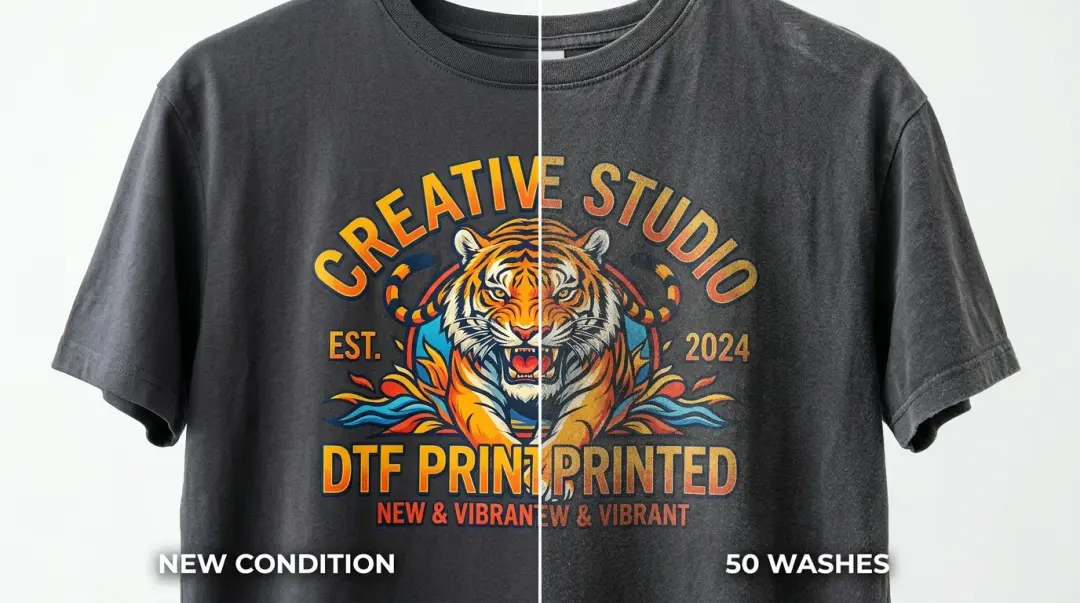
Wash durability is the gold standard that separates a professional-grade DTF (Direct to Film) print from a disposable promotional garment. While marketing materials often promise "indestructible" results, the reality revealed by controlled durability testing tells a more nuanced story. Understanding exactly what happens to a DTF transfer by the 50-wash milestone is critical for shop owners looking to manage customer expectations and improve product quality.
The 50-Wash Benchmark: What to Expect
When a high-quality DTF transfer is applied according to strict technical specifications, the results are remarkably stable. In controlled testing environments, a correctly pressed transfer on 100% cotton consistently maintains full visual integrity through 50 to 70 wash cycles. By the time the garment reaches the 50-wash mark, the most common observation is not structural failure, but rather subtle changes that often favor the wearer.
Visual Integrity and Color Vibrancy
By cycle 50, color vibrancy experiences a modest, expected reduction of approximately 5–10%. To the average observer, this is visually acceptable and remarkably comparable to the behavior of screen-printed plastisol inks over an identical wash count. The design does not typically "wash out" but rather settles into the fabric, appearing more natural and less like a surface-applied decal.
The Evolution of Hand Feel
A frequent concern for customers is the initial "stiffness" of a fresh DTF print. Interestingly, the design's hand feel softens significantly with repeated laundering. This occurs as the TPU adhesive powder layer gradually conforms to the microscopic texture of the fabric fibers. Most wearers find that this evolution makes the garment more comfortable, transforming what was once a rigid print into a soft, flexible element of the apparel.
Why DTF Prints Fail: Identifying the Vulnerabilities
If a print fails before the 50-wash threshold, it is almost exclusively the result of compromised application processes. Durability in DTF is a direct product of the chemical bond between the adhesive and the substrate.
| Failure Factor | Typical Wash Failure Cycle | Root Cause |
|---|---|---|
| Under-pressing | 10–15 | Insufficient heat/dwell time preventing adhesive activation |
| No Finishing Press | 15+ | Incomplete bonding into fabric pores |
| Improper Synthetic Heat | 20–30 | Thermal damage to fibers undermining bond integrity |
| Aggressive Washing/Drying | 25–40 | Thermal and mechanical degradation of the adhesive layer |
The Role of Application Precision
The structural failure mode of a compromised DTF print usually manifests as edge lifting. If a transfer is under-pressed (insufficient temperature or dwell time), edge lifting can begin as early as cycle 10, with total structural failure occurring by cycle 30. Similarly, skipping the crucial finishing press—the step that forces the melted adhesive into the garment's weave—leads to accelerated edge failure starting around cycle 15.
Fabric-Specific Durability Considerations
Durability is not one-size-fits-all across different textiles. While cotton is highly forgiving, synthetic materials like polyester require precision. When pressing on polyester, temperature must be dialed in to the 260–280°F range. Using "cotton-standard" temperatures (often 300°F+) on synthetic fabrics causes thermal damage to the textile fibers. This damage undermines the adhesive bond, reducing effective durability to a mere 20–30 cycles.
The Lowest-Cost Durability Improvement: Customer Education
Perhaps the most controllable variable in the entire lifecycle of the print is the end-user's wash care protocol. Mechanical abrasion and high-heat cycles are the enemies of longevity. Transfers subjected to hot water (above 60°C) and high-heat tumble drying consistently show failure rates 40–50% higher than those washed in cold water and air-dried.
Key Takeaway: Providing comprehensive, clear wash-care instructions with every order is the single most effective, low-cost method to extend the lifespan of your DTF prints. Educating your customer isn't just service; it's a quality control measure.
By shifting the focus from simply "printing" to "engineering" the final product—through correct application, material matching, and customer education—shops can ensure that their DTF prints remain vibrant and intact well past the 50-wash mark, ensuring long-term customer satisfaction and brand loyalty.
Frequently Asked Questions
How long should a high-quality DTF print last on a garment?
Why does the feel of a DTF print change after several washes?
What are the most common causes of premature DTF print failure?
Does the type of fabric affect how long a DTF print lasts?
How can I help my customers extend the life of their DTF prints?
Comments
No comments yet. Be the first to share your thoughts!