
DTF Material Compatibility: Hard Surfaces vs. Fabric
Confused about DTF on hard surfaces? Discover why standard DTF fails on metal and plastic, and why UV DTF is the solution for stainless steel, wood, and more.
Understanding DTF Material Compatibility
As the customization industry evolves, many creators find themselves asking: What materials are compatible with UV DTF printing? The answer depends entirely on which "DTF" process you are using. There is a fundamental, functional difference between standard textile DTF and the increasingly popular UV DTF technology.
Standard DTF vs. UV DTF: Know the Difference
It is vital to distinguish between these two technologies to avoid project failure. Standard Direct-to-Film (DTF) is engineered specifically for textiles. It relies on a heat-press application process that activates a thermoplastic powder, which then melts into the fibers of fabrics like cotton, polyester, and blends. Because it requires heat and fiber penetration, it generally does not bond to rigid, non-porous surfaces.
In contrast, UV DTF (Direct to Film using UV-cured ink) uses a specialized, clear adhesive film. This process requires no heat press, making it the industry standard for hard, rigid items.
Compatible Materials for UV DTF
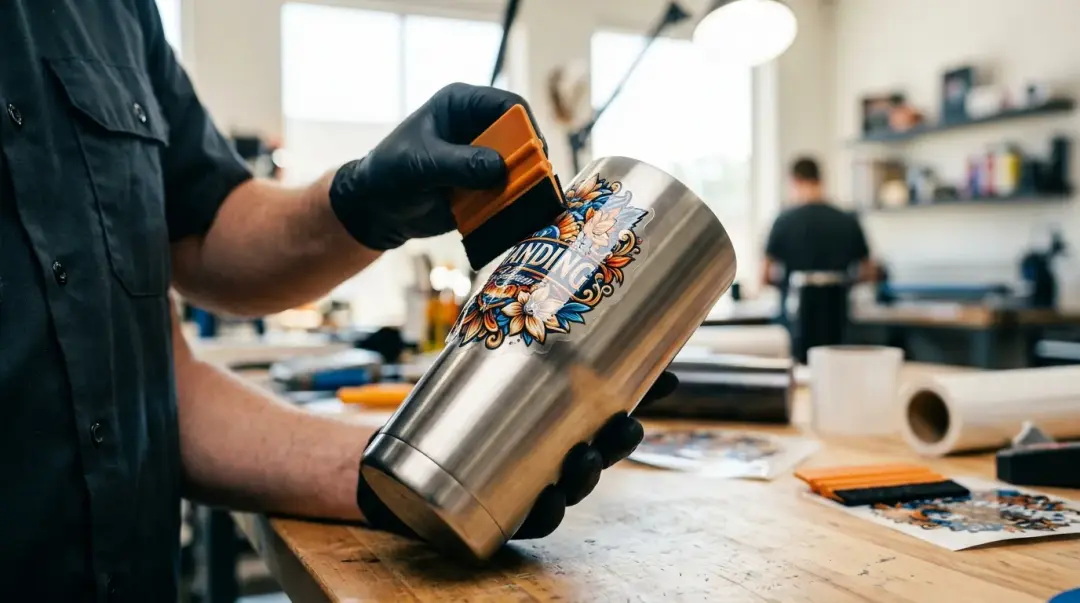
UV DTF is the superior choice for smooth, non-porous surfaces. The adhesive is pressure-sensitive, allowing you to simply peel, stick, and squeegee the design onto your item.
| Material | Compatibility | Key Note |
|---|---|---|
| Stainless Steel | Excellent | Best for tumblers and drinkware; must be clean. |
| Aluminum | Excellent | Ideal for signage and promotional metal goods. |
| Hard Plastic | Good | Requires sufficient surface energy for adhesion. |
| Wood | Conditional | Must be sealed/finished to be non-porous. |
| Silicone | Problematic | Low surface energy makes adhesion very difficult. |
Hard Metals (Stainless Steel & Aluminum)
Metals like stainless steel and aluminum are the gold standard for UV DTF. Because they are non-porous and generally smooth, the pressure-sensitive adhesive bonds exceptionally well. Whether you are creating custom stainless steel tumblers or industrial aluminum nameplates, UV DTF provides a durable, vibrant finish.
Navigating Difficult Substrates: Wood and Silicone
While the general rule for UV DTF is "smooth, clean, and non-porous," some materials require extra preparation:
- Wood: Raw or rough wood is highly porous, which prevents the adhesive from establishing a strong bond. To use UV DTF on wood, you must first seal or finish the surface to create a smooth, non-porous layer.
- Silicone: This is arguably the most difficult material. Silicone has extremely low surface energy, which inherently resists adhesion. Results are often inconsistent. Always perform a test application before committing to a full production run on silicone items.
How to Apply UV DTF Transfers
The UV DTF process is entirely tool-free, making it accessible for small-batch production:
- Clean the Surface: Use isopropyl alcohol to remove oils, dust, and fingerprints. A clean surface is critical for long-term adhesion.
- Peel: Remove the paper backing from your UV DTF transfer.
- Press: Place the design onto the item. Because the adhesive is instant, position it carefully.
- Squeegee: Firmly squeegee the design from the center outward to eliminate air bubbles and ensure the adhesive is fully activated against the substrate.
Key Takeaway: UV DTF is a cold-application process. Unlike textile DTF, which melts into fabric, UV DTF relies on a pressure-sensitive adhesive. For best results, avoid porous textures and always test difficult materials like raw wood or silicone.
Care and Durability
UV DTF transfers are water-resistant, but they are not indestructible. To maximize the longevity of your custom goods, hand-washing is strongly recommended. Repeated cycles in a dishwasher subject the transfers to high heat and abrasive detergents, which can cause the edges to lift or peel over time. For promotional items or signage, this process offers the vibrant, professional look that traditional heat-press methods simply cannot achieve on hard goods.
Frequently Asked Questions
What is the main difference between standard textile DTF and UV DTF?
Why is cleaning a surface with isopropyl alcohol critical for UV DTF?
Can I use UV DTF on wood surfaces?
Are items decorated with UV DTF dishwasher safe?
Why is silicone considered a difficult material for UV DTF?
Comments
No comments yet. Be the first to share your thoughts!