
DTF vs. Ready-to-Press Screen Printed Transfers: Key Differences
Confused between DTF transfers and ready-to-press screen printed transfers? Discover the cost, quality, and volume differences to choose the right tech.
Understanding Transfer Technology in Apparel Decoration
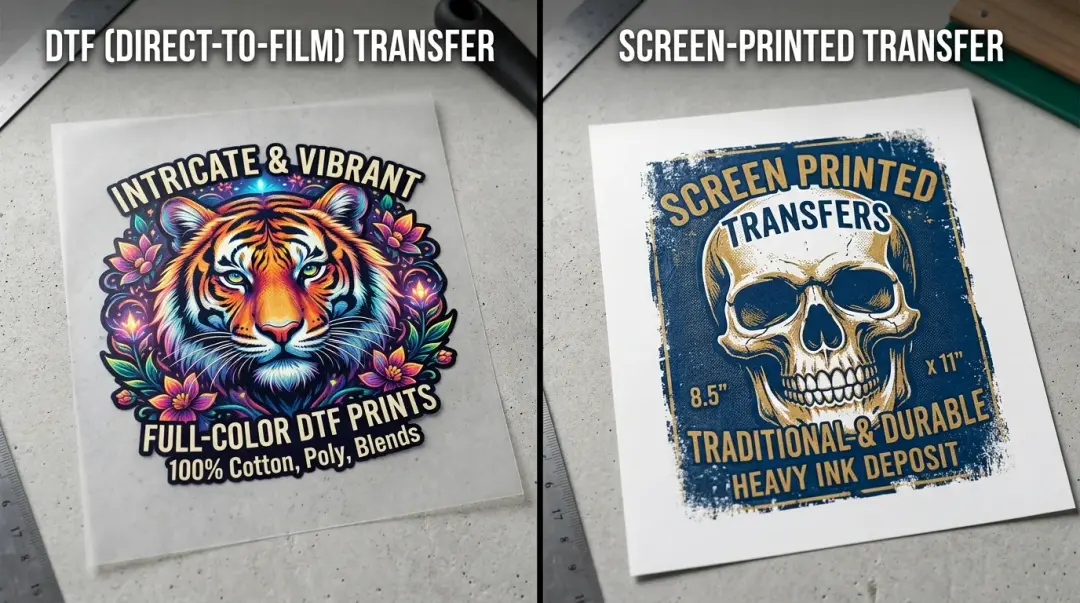
For custom apparel decorators, choosing the right transfer method is critical to balancing profitability, production speed, and print quality. While Direct to Film (DTF) and Ready-to-Press Screen Printed Transfers (SPTs) both utilize a heat press to apply designs to garments, they are fundamentally different technologies that serve distinct business needs.
Understanding the nuance between these two options allows shops to optimize their workflow, whether they are focusing on one-off custom orders or high-volume recurring production. For more information, read our Blog — DTF vs other methods comparison article, add as internal comparison section.
What Are Ready-to-Press Screen Printed Transfers?
Screen printed transfers, often referred to as plastisol transfers, are a time-tested industry standard. They are produced by screen printing designs onto special release paper using heavy-duty plastisol ink. Unlike traditional screen printing, where ink is applied directly to the garment, these transfers are cured to a "tacky" state and sold as ready-to-use sheets for later application.
Key Characteristics of SPTs:
- Durability: Plastisol ink is known for its opacity, vibrancy, and exceptional wash fastness.
- Aesthetic: They provide that classic, premium "screen-printed" feel that many customers associate with high-quality retail apparel.
- Limitations: Due to screen setup requirements, they carry high upfront costs and minimum order quantities (MOQs), typically ranging from 50 to 144 pieces per design. They are also limited by color count and cannot easily reproduce gradients or photographic detail.
What Are DTF Transfers?
DTF printing is a digital technology that prints full-color designs onto a special PET film using water-based inks. After printing, a TPU adhesive powder is applied and cured, creating a transfer that can be heat-pressed onto almost any fabric type, including polyester, cotton, and blends.
Key Characteristics of DTF:
- Versatility: No minimum order quantities and zero setup costs make it perfect for on-demand or small-batch production.
- Design Freedom: DTF can reproduce complex photographic imagery, fine details, and smooth gradients without color limits.
- Efficiency: Digital workflows allow for instant transition between entirely different designs, maximizing production flexibility.
Comparison Table: DTF vs. Screen Printed Transfers
| Feature | DTF Transfers | Screen Printed Transfers |
|---|---|---|
| MOQ | None (1 piece) | High (50–144+ pieces) |
| Setup Costs | Zero | High (Screen/Film costs) |
| Design Complexity | Unlimited (Photos, gradients) | Limited (Solid colors) |
| Production Scale | Small/Medium/On-demand | High Volume/Recurring |
Which Method Should You Use?
The choice between these technologies often comes down to the specific job requirements. DTF transfers win on flexibility and speed for small-batch custom work. If you are handling a mixed-design order or a client needing a single prototype, DTF is significantly more cost-effective and faster to produce.
Conversely, screen printed transfers remain the king of efficiency for large, identical runs. If you have a client ordering 200 branded hoodies with a single-color logo, the per-unit cost of a screen printed transfer will almost always undercut DTF. Furthermore, if your client base specifically demands the heavy, traditional plastisol feel, screen printed transfers satisfy that market expectation perfectly.
Key Takeaway: Many successful print shops integrate both workflows. Use DTF for custom, small-batch, and complex designs, while maintaining relationships with screen print transfer providers for high-volume, recurring orders of branded basics. One does not necessarily replace the other; they complement each other to cover all market segments.
Final Verdict
If you are a new shop or expanding your capabilities, DTF should be your first investment due to its lack of barriers to entry (no MOQs). Once your business grows and you identify high-volume accounts, you can layer in ready-to-press screen printed transfers to drive down costs on your largest, most consistent jobs.
Frequently Asked Questions
What is the primary difference between DTF transfers and screen printed transfers?
When should I choose DTF printing over screen printed transfers?
Are screen printed transfers still useful for high-volume production?
Does DTF printing have specific design limitations like screen printing?
Can a print shop successfully integrate both DTF and screen printed transfers?
Comments
No comments yet. Be the first to share your thoughts!