
Outsourcing DTF vs. Printing In-House: A Real-World Cost Breakdown
Deciding between outsourcing DTF transfers or printing in-house? We break down the true cost of ownership, ROI, and operational realities to help you choose.
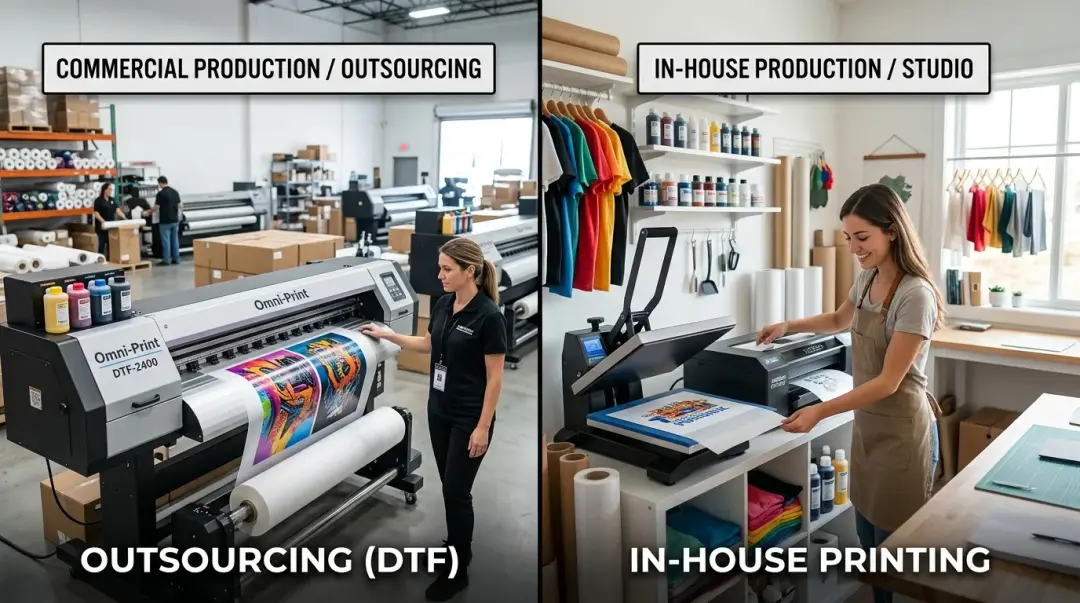
For growing apparel decorators, the decision to bring Direct to Film (DTF) printing in-house or continue outsourcing is a pivotal financial crossroad. While the promise of lower per-transfer costs is enticing, the reality of total cost of ownership (TCO) is far more nuanced. Understanding the true trade-off between upfront investment and long-term operational efficiency is critical for scaling your business profitably.
The Economic Landscape of DTF Production
Outsourcing DTF transfers offers a low-risk, predictable operational model. It eliminates the need for expensive equipment, specialized facility requirements, and the technical expertise required to manage high-precision printheads. However, this convenience comes at a premium. Wholesale DTF suppliers typically charge $2–$6 per transfer, depending on volume, artwork complexity, and turnaround requirements.
Conversely, in-house production shifts the model from a variable expense to a capital-intensive one. An entry-level, professional 24-inch DTF production system—incorporating the printer, automated powder shaker, curing oven, professional-grade heat press, RIP software, and initial consumable stock—requires an upfront investment typically ranging from $18,000 to $30,000.
Breaking Down the Total Cost of Ownership (TCO)
To determine if in-house production is viable, you must look beyond the raw material costs. While it is true that an in-house setup can drive material costs down to $1–$2 per transfer, that figure is only one piece of the puzzle.
Hidden Costs of In-House Printing
- Printhead Maintenance & Replacement: DTF printheads are the most sensitive and expensive component. At high production volumes, these components often require replacement every 6–12 months, with costs reaching approximately $1,000 per head.
- Waste and Calibration: Unlike outsourcing, where you pay for a finished, tested product, in-house printing involves inherent waste. Misprints, color profiling errors, and daily maintenance cycles (white ink agitation, head cleaning) consume ink and film, which must be factored into your margin.
- Labor and Time: Running a DTF line is not a \"set and forget\" operation. Daily upkeep, machine monitoring, curing oven operation, and troubleshooting demand significant labor hours that could otherwise be spent on sales or finishing.
\nKey Takeaway: The margin advantage of in-house printing is frequently eroded at lower volumes. Only when your consistent, daily volume is high enough to amortize the cost of equipment and maintenance does in-house printing become significantly more profitable than outsourcing.\n
Outsourcing vs. In-House: Decision Matrix
| FactorOutsourcingIn-House Printing | ||
| Upfront Capital | Low / Zero | High ($18k–$30k+) |
| Cost Per Print | $2.00 – $6.00 | $1.00 – $2.00 |
| Operational Risk | Minimal | High (Maintenance/Clogs) |
| Scalability | Linear (Pay per order) | Step-based (Add equipment) |
Strategic Recommendations for Growth
Before committing to an in-house system, evaluate your current workflow. If your business primarily handles low-volume, high-variety orders, the flexibility of outsource DTF printing vs in-house cost comparison may actually yield higher net profits by keeping your overhead lean. Conversely, if you have a consistent pipeline of repeat orders that pushes your monthly transfer spend well into the thousands, bringing production in-house allows you to capture that margin while gaining control over lead times and quality.
Expert Tip: Calculate your \"break-even\" volume. Take your total projected monthly transfer spend, subtract the cost of consumables, and divide that by the monthly cost of financing the equipment, plus estimated maintenance overhead. If that number exceeds your current monthly transfer volume by more than 20%, you are likely not ready to bring production in-house.
Frequently Asked Questions
What are the primary financial benefits of outsourcing DTF transfers versus printing in-house?
Why should I consider the Total Cost of Ownership (TCO) when buying a DTF printer?
How do I determine if my business is ready to bring DTF production in-house?
Is in-house DTF printing considered a 'set and forget' operation?
What is the biggest operational risk when owning an in-house DTF printer?
Comments
No comments yet. Be the first to share your thoughts!