
Roland BN-20D Review: Who It's Really For and What to Expect
Considering the Roland BN-20D for your DTF shop? Learn who this desktop printer is for, its dual-purpose benefits, and the realistic production limitations.
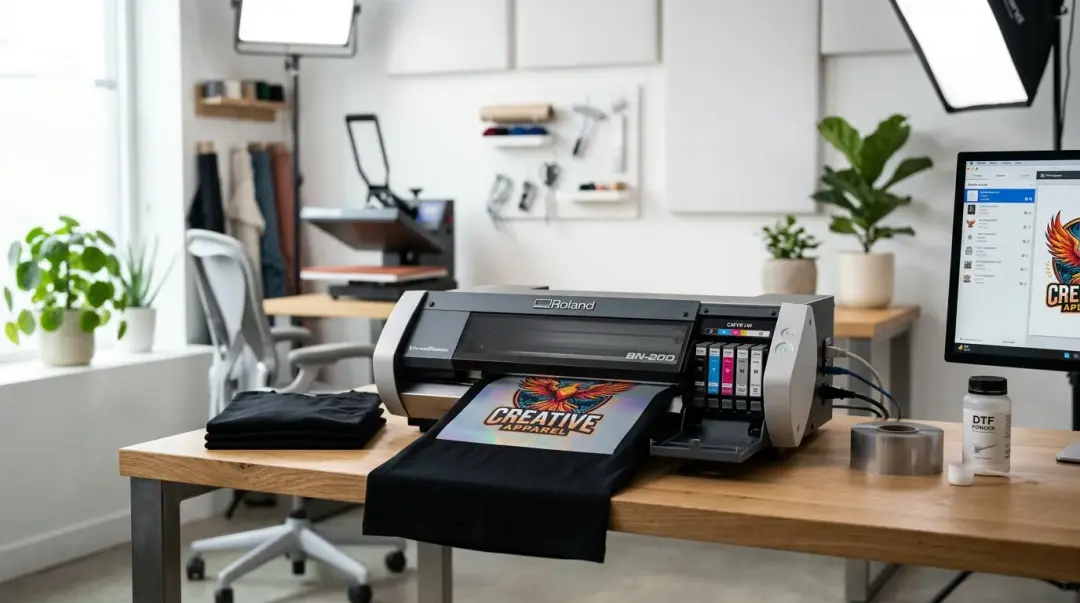
The Roland VersaSTUDIO BN-20D occupies a unique niche in the apparel decoration industry. As one of the most recognizable desktop Direct-to-Film (DTF) printers, it brings Roland’s legendary reputation for mechanical reliability into a compact, 20-inch roll-fed format. For small businesses, home-based shops, and boutique garment decorators, the BN-20D promises pro-level output without requiring industrial floor space. However, understanding its specific design architecture is critical before investing. You can find more information in our Blog — DTF gear reviews or printer comparison category.
Key Specifications and Performance
The BN-20D is built for quality rather than high-speed mass production. With an output resolution of up to 1,440 DPI, it excels at reproducing intricate artwork, fine-line details, and vibrant colors using its CMYK + White ink configuration. The machine is driven by Roland’s industry-standard VersaWorks 6 RIP software, which provides robust control over color management and layout.
| Feature | Specification |
|---|---|
| Print Technology | Inkjet (CMYK + White) |
| Max Resolution | 1,440 DPI |
| Integrated Cutting | Yes (Standalone Vinyl Cutter) |
| Footprint | Approx. 42 inches wide |
| Print Speed | ~1.19 m²/hr |
The True Advantage: Dual-Purpose Functionality
One of the BN-20D's most compelling features is its ability to double as a standalone vinyl cutter. This is a game-changer for shops that do not want to invest in—or find space for—two separate machines. You can switch between printing DTF transfers and cutting heat transfer vinyl (HTV) or decals, making it a highly versatile asset for limited workspace environments. Its build quality is robust, providing a professional-grade feel that entry-level, modified desktop printers often lack.
Understanding the Limitations
While the machine is reliable, it is essential to manage expectations regarding throughput. The BN-20D uses a bi-directional print architecture. It prints the color layer, rolls the film back, and then prints the white layer on top. This process inherently slows down production compared to single-pass printers.
Because of this printing method, the BN-20D cannot connect inline to automated powder shakers and curing systems. Manual intervention is required for every print run—you must manually apply the TPU adhesive powder and cure each sheet. If your business reaches a volume of more than 30–40 transfers per session, this becomes a significant production bottleneck.
BN-20D vs. The Evolution: The BY-20
It is impossible to discuss the BN-20D without mentioning its successor, the Roland BY-20. The BY-20 introduced a single-pass printing architecture, allowing for significantly faster output speeds (up to 2.34 m²/hr) and compatibility with inline automation. If you are a shop planning for scaling, the BY-20 is objectively the superior long-term investment.
Key Takeaway: The BN-20D remains a fantastic, reliable machine for low-volume shops or businesses prioritizing high-quality, fine-detail work over sheer speed. If your primary goal is rapid growth and high-volume throughput, consider the BY-20 instead.
Cost Considerations
The entry price for the printer body typically hovers around $6,500. However, prospective buyers should budget an additional $1,500–$2,500 to cover the total startup ecosystem, including:
- Initial ink sets
- PET film supplies
- TPU adhesive powder
- Curing equipment (oven or heat press)
- Necessary venting/fume extraction
Final Verdict: Who is the BN-20D For?
The Roland BN-20D is ideal for the boutique decorator who values brand reliability and needs a multi-functional machine. It is perfect for those producing custom, high-end apparel where print quality and fine-line detail are prioritized over mass-production speed. If you are starting your journey into garment decoration and value a compact, well-supported system that can also handle your vinyl cutting needs, the BN-20D is a solid entry point into professional-grade DTF.
Frequently Asked Questions
Is the Roland BN-20D suitable for high-volume DTF apparel production?
How does the Roland BN-20D differ from the newer Roland BY-20?
Can the Roland BN-20D perform tasks other than DTF printing?
What is the total estimated budget required to start using a BN-20D?
Why is the BN-20D considered an ideal choice for boutique garment decorators?
Comments
No comments yet. Be the first to share your thoughts!