
DTF Print-on-Demand vs. Holding Inventory: Which Is Better?
Struggling to scale your DTF business? Compare the pros and cons of print-on-demand vs. holding transfer inventory to optimize your fulfillment strategy.
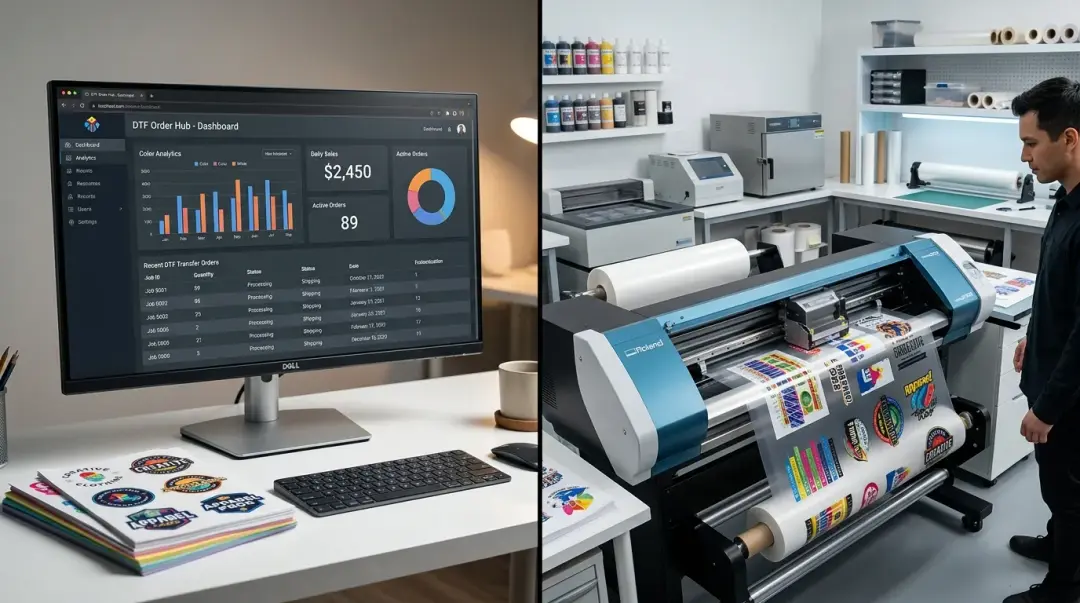
Choosing Your DTF Fulfillment Strategy
As DTF (Direct to Film) businesses scale, the decision of how to handle production becomes a critical operational pivot. For many, the choice boils down to two distinct paths: DTF Print-on-Demand (POD) or holding pre-printed transfer inventory. Neither model is inherently superior; instead, the "better" choice depends entirely on your current volume, risk tolerance, and the expectations of your target customer base.
Understanding the balance between cost, speed, and risk is the key to maintaining healthy cash flow while satisfying customer demand in a competitive e-commerce landscape.
The Case for DTF Print-on-Demand
Print-on-demand (POD) remains the go-to model for startups, niche testers, and seasonal sellers. By utilizing a transfer supplier who produces prints only after an order is placed, you eliminate the risk of dead stock.
Benefits of the POD Model
- Zero Inventory Risk: You never pay for transfers that don't sell. This is ideal for testing new designs or seasonal niches.
- Low Upfront Investment: Capital that would otherwise be tied up in stock can be reinvested into marketing or R&D.
- Infinite Scalability: You can offer hundreds of designs simultaneously without the need for physical storage or complex organization systems.
The Fulfillment Friction
The primary drawback of POD is the production lead time. Even elite DTF suppliers typically require 24–48 hours to print and ship. In an era where consumers are conditioned by Amazon’s two-day shipping expectations, waiting three to five days just to receive the transfer—plus the time to press it onto a garment—can frustrate buyers. For sellers relying on platforms like Etsy or Shopify, this delay can lead to poor reviews and lost repeat customers.
The Strategic Advantage of Holding Inventory
Holding a small, curated inventory of your top-selling designs solves the speed problem. You are essentially shifting to a "just-in-case" model for your core products while keeping the rest of your catalog on a "just-in-time" (POD) basis.
Optimizing Your Stock
To implement this effectively, focus on your 10–20 best-selling evergreen designs—think American flags, pet graphics, or holiday staples. When sealed correctly in a dry, room-temperature environment, PET film transfers can remain stable for 6–12 months, providing you with a significant window to fulfill orders same-day.
Data-Driven Inventory Management
Lean inventory requires strict monitoring. Use tools like Shopify’s inventory analytics or a simple spreadsheet to track your units ordered vs. units sold per design. A good rule of thumb is the 60-day threshold: if a design hasn't moved in two months, stop re-ordering it. This keeps your cash flow healthy and prevents dead stock from accumulating.
| Feature | Print-on-Demand (POD) | Holding Inventory |
|---|---|---|
| Risk | Low (No dead stock) | Moderate (Requires monitoring) |
| Fulfillment Speed | Slower (Production wait time) | Fast (Ship same-day) |
| Upfront Cost | Minimal | Moderate |
| Best Use Case | Testing, Custom/Seasonal | Evergreen/Bestselling designs |
The Hybrid Approach: The Scaling Secret
Many successful DTF sellers eventually adopt a hybrid model. This approach mitigates risk while drastically improving the customer experience. By keeping stock of evergreen designs, you guarantee fast delivery for your high-volume items, while using POD to handle custom requests or experimental seasonal drops.
Key Takeaway: Don't try to hold inventory for every design. Curate your stock to your top 10% of high-movers to maximize cash flow and fulfillment speed simultaneously. Utilize POD for everything else to keep your operational overhead low.
Ultimately, the transition from pure POD to a hybrid model is a sign of a healthy, maturing business. By listening to your data and responding to your customers' demand for speed, you can build a more resilient and profitable DTF brand.
Frequently Asked Questions
What is the main difference between DTF Print-on-Demand (POD) and holding inventory?
How long can I store DTF transfers before they go bad?
How do I decide which designs to stock versus using POD?
What is the 60-day rule for managing DTF transfer inventory?
Why might POD be a disadvantage for my customer experience?
Comments
No comments yet. Be the first to share your thoughts!