
DTF vs. Screen Printing: Which Is Right for Your Business?
Choosing between DTF and screen printing? Learn which method fits your production volume, budget, and design complexity to scale your apparel business efficiently.
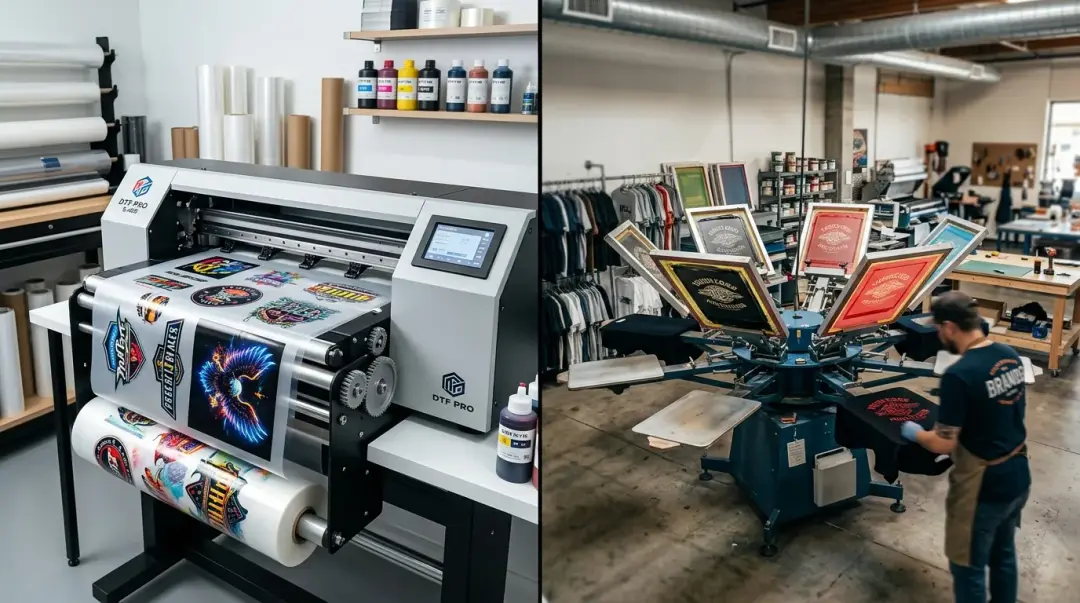
Choosing the right decoration method is a pivotal decision for any apparel business. For decades, screen printing reigned supreme as the industry standard for high-volume apparel, but the rise of DTF (Direct to Film) printing has fundamentally disrupted this landscape. For business owners, the choice between these two technologies often dictates your profit margins, order turnaround times, and scalability.
Understanding the Core Differences
To make an informed decision, it is essential to distinguish the operational realities of both technologies. Screen printing is an analog process that requires the creation of physical stencils (screens) for every color in a design. Conversely, Direct to Film is a digital, on-demand process that prints full-color, high-resolution graphics onto a transfer film, which is then heat-pressed onto the garment.
Screen Printing: The High-Volume Powerhouse
Screen printing remains the gold standard for large, uniform runs. Because the cost of burning screens and setting up the press is amortized over hundreds or thousands of units, the per-unit cost drops significantly as volume increases. However, the process is labor-intensive and rigid, requiring specialized expertise and significant space for equipment and drying.
DTF: The Digital Flexible Solution
DTF technology removes the traditional barriers of entry. Because it is a digital process, there are no screens to burn, no color separation charges, and no minimum order quantities (MOQs). This allows business owners to print anything from a single, complex, multi-colored graphic to a large batch, all with the same consistent per-square-inch cost.
Comparison: DTF vs. Screen Printing
| Feature | Screen Printing | DTF (Direct to Film) |
|---|---|---|
| Setup Costs | High (Screens per color) | Minimal/None |
| Minimums | High (usually 24-50+) | None (Print 1 or 1,000) |
| Complexity | Limited (best for spot colors) | Unlimited (photographic/gradients) |
| Turnaround | Long (requires staging/setup) | Fast (on-demand capable) |
Key Considerations for Your Business Model
Deciding which method is "right" depends entirely on your specific business goals. If your revenue model relies on bulk orders for teams or local organizations with simple designs, screen printing offers a competitive edge in unit economics. However, if your business focuses on custom apparel, e-commerce, or Etsy-style on-demand fulfillment, DTF is vastly more scalable.
Why DTF is Often the Superior Choice for Growth
- Inventory Efficiency: With DTF, you can stock blank apparel and print transfers on demand, drastically reducing capital tied up in pre-printed inventory.
- Design Freedom: DTF handles gradients, photos, and unlimited colors without additional costs, allowing you to charge a premium for complex, full-color designs.
- Reduced Risk: Without high MOQs, you can test new designs or market trends without the financial risk of unsold bulk inventory.
Key Takeaway: For small businesses and those specializing in variety, quick turnarounds, or on-demand fulfillment, DTF printing is typically the more cost-effective and scalable choice. Screen printing's advantages are limited to high-volume, simple design orders where the cost of setup can be effectively absorbed.
Final Verdict
As the industry evolves, the trend is clearly shifting toward digital solutions. For a business looking to stay agile and responsive to market demands, investing in DTF or building partnerships with transfer providers offers a clear path to profitability. Assess your current order patterns, calculate your average order size, and consider whether the setup overhead of screen printing is actually holding your growth back.
Frequently Asked Questions
What is the primary difference between DTF and screen printing?
Why is DTF often considered better for small businesses or on-demand printing?
Can DTF handle complex designs like photographs and gradients?
When is screen printing still the better option for apparel businesses?
Does switching to DTF help with inventory management?
Comments
No comments yet. Be the first to share your thoughts!