
Screen Printing vs. DTF in 2026: An Honest Side-by-Side
Struggling to choose between screen printing and DTF in 2026? We break down the costs, speed, and best use cases for each to help you scale your apparel business.
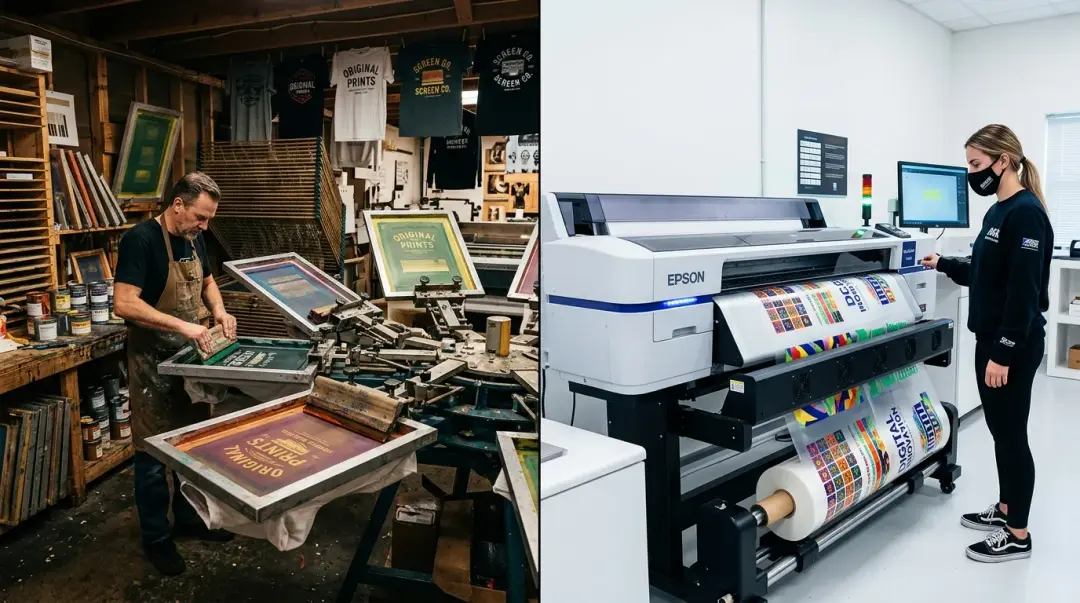
The Modern Print Landscape: 2026 Edition
For decades, screen printing has served as the backbone of the custom apparel industry. It is the gold standard for high-volume, durable branding. However, the rise of Direct-to-Film (DTF) technology has fundamentally shifted the operational dynamics of print shops worldwide. In 2026, the question is no longer which method is "better," but rather which method aligns with your specific business model.
Understanding this transition is essential for any apparel entrepreneur. Whether you are running a boutique brand or a high-volume fulfillment center, choosing the wrong production method can be the difference between a healthy margin and lost potential.
The Case for Traditional Screen Printing
Screen printing relies on the application of plastisol inks pushed through a mesh screen onto a garment. This process creates a thick, high-opacity layer that is synonymous with the classic t-shirt feel. According to industry analysis, screen printing remains the economic powerhouse for specific, high-volume scenarios.
Key Advantages of Screen Printing
- Lowest Cost-Per-Unit: On orders exceeding 72–100 pieces with a simple 1–4 color design, screen printing delivers unmatched economies of scale.
- Durability: Properly cured plastisol inks are renowned for their ability to withstand hundreds of wash cycles without fading or cracking.
- Vibrant Saturation: Screen printing offers a depth of color that remains the benchmark for premium apparel, particularly on dark fabrics.
The Practical Trade-offs
The barriers to entry in screen printing are logistical. Each individual color in a design requires a separate screen, costing between $20 and $40 per screen. Furthermore, setup time typically ranges from 45 to 90 minutes before a single shirt is printed. Because of these high fixed costs, shops usually enforce minimum orders of 24–48 pieces to ensure profitability.
Why DTF is Disrupting Production in 2026
DTF technology has eliminated the traditional constraints of screen printing. By printing designs onto a specialized PET film with a TPU adhesive powder, shops can bypass screens, emulsions, and complex setup processes entirely. This shift has made DTF the operational leader for on-demand and small-batch production.
Operational Advantages of DTF
- Zero Setup Fees: Since no screens are required, you can print a single piece or one thousand pieces with equal efficiency.
- Design Flexibility: Full-color, photographic, and gradient-heavy designs are printed at the same cost as a single-color logo.
- Speed to Market: With no 45-minute setup, production can start almost immediately upon file preparation.
Key Takeaway: In 2026, DTF has evolved from a niche method into the primary production engine for most growing custom apparel shops. Its ability to handle infinite variety without dead inventory is its greatest asset.
Side-by-Side Comparison: 2026 Operational Metrics
| Metric | Screen Printing | DTF Printing |
|---|---|---|
| Setup Costs | High ($20–$40 per screen) | None |
| Minimum Orders | Typical (24–48+ pieces) | None (1+ pieces) |
| Color Limits | Strict (Cost increases per color) | Unlimited (No extra cost) |
| Best For | High-volume, simple designs | On-demand, complex/varied designs |
Making the Choice for Your Business
Your business model dictates your technology path. If your shop thrives on recurring contracts for 500 identical black shirts with a 1-color logo, the efficiency of screen printing will consistently outperform digital alternatives. The amortization of setup costs over large volumes makes it the clear economic winner.
Conversely, if your model involves taking custom orders from 50 different clients each week—each with different designs, garment sizes, and fabric colors—DTF is operationally superior. The flexibility to swap designs instantaneously allows for a level of customer service and inventory management that is physically impossible to achieve with traditional screen setups.
Ultimately, many successful shops in 2026 have adopted a hybrid approach. They utilize DTF for the overwhelming majority of their day-to-day operations and selectively outsource screen printing to specialized partners for those rare, high-volume, simple-design runs where the economics remain firmly in favor of the screen.
Frequently Asked Questions
How does DTF printing differ from screen printing in terms of setup costs?
Which production method is better for high-volume orders?
Is DTF printing suitable for photographic or gradient-heavy designs?
What is the role of TPU adhesive powder in the DTF process?
Why do many successful print shops adopt a hybrid approach in 2026?
Comments
No comments yet. Be the first to share your thoughts!