
Standard DTF vs. UV DTF: Which Do You Actually Need?
Confused by the DTF acronym? Learn the critical differences between Standard DTF and UV DTF to ensure you choose the right printing method for your business.
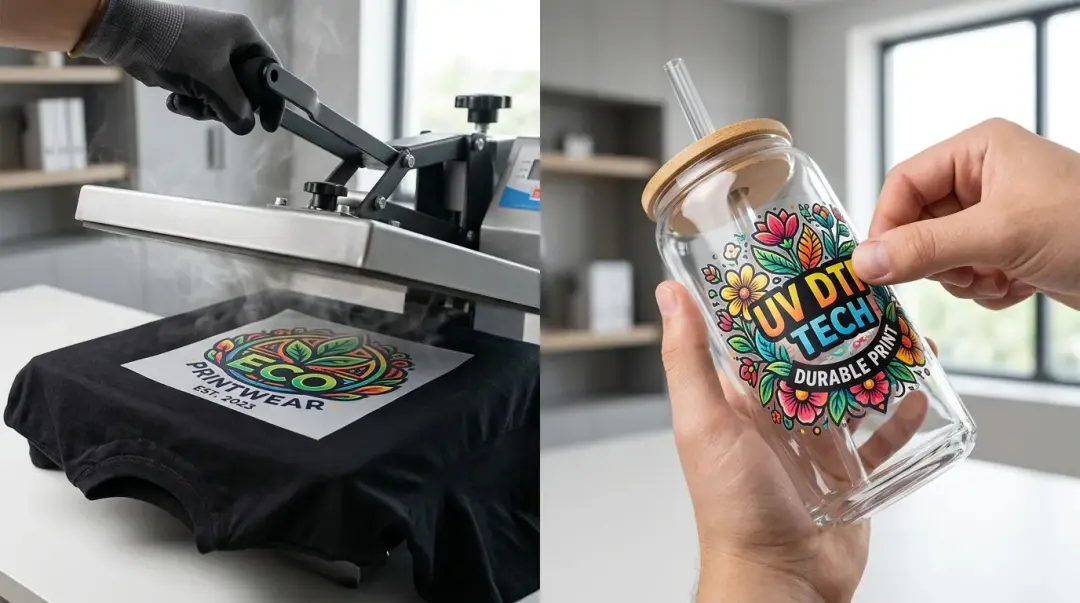
Standard DTF vs. UV DTF: Understanding the Core Differences
In the world of custom printing, the term "DTF" has become a buzzword that often causes more confusion than clarity. While both Standard DTF (Direct to Film) and UV DTF (Ultraviolet Direct to Film) share the same acronym, they are fundamentally different technologies designed for entirely different markets. Choosing the wrong one can lead to wasted investment and failed product applications.
To put it simply: Standard DTF is for fabric decoration, while UV DTF is for hard surface personalization. Understanding this distinction is the first step toward scaling your business effectively.
The Technical Divide: Workflow and Application
The confusion stems from the fact that both technologies involve printing on a film. However, the chemistry and application methods are worlds apart.
Standard DTF: The Fabric Specialist
Standard DTF is a thermal transfer process. The process involves printing full-color designs onto a specialized PET film using water-based pigment inks. A hot-melt adhesive powder is applied to the wet ink, cured, and then transferred to the fabric using a commercial heat press at temperatures between 280–320°F (138–160°C).
- Substrates: Cotton, polyester, blends, denim, and canvas.
- Finish: Soft, flexible, and stretchable; integrates into the garment fibers.
- Durability: Highly wash-fast when applied correctly.
UV DTF: The Hard Goods Solution
UV DTF is a "peel-and-stick" technology that bypasses the heat press entirely. It uses UV-curable inks printed onto a clear release film and laminated with a special adhesive film. The final product is a pressure-sensitive decal that can be applied by hand to almost any rigid surface.
- Substrates: Glass, metal, plastic, ceramic, wood, and acrylic.
- Finish: Rigid, 3D/raised effect, highly scratch-resistant and waterproof.
- Application: No heat required; ideal for odd-shaped items like tumblers.
Comparison Table: Quick Reference
| Feature | Standard DTF | UV DTF |
|---|---|---|
| Target Material | Fabrics/Apparel | Rigid/Hard Goods |
| Application | Heat Press Required | Peel & Stick (No Heat) |
| Ink Type | Pigment (Water-based) | UV-Curable |
| Best Use-Case | T-shirts, hoodies, bags | Tumblers, awards, signage |
Business Implications: Which Market Should You Target?
Your choice of technology defines your customer base. Standard DTF positions you as an apparel decorator. Your clients are clothing brands, school sports teams, and local businesses needing branded merch. It is a high-volume market driven by the constant demand for custom apparel.
Conversely, UV DTF positions you as a hard goods customizer. Your clients are promotional product buyers, event planners, and corporate gift providers. Because UV DTF requires no heat, it is one of the lowest-barrier product expansions for existing print shops. You can customize tumblers, phone cases, and acrylic awards without buying a heat press or investing in specialized laser engraving machinery.
Key Takeaway: Many successful shops offer both. The client buying custom branded t-shirts for their staff usually also needs branded drinkware for their events. Integrating both technologies allows you to become a one-stop-shop for all custom branding needs.
How to Decide What You Need
Ask yourself two questions to determine your path:
- What is the primary material I am decorating? If it’s soft and wearable, choose Standard DTF. If it's hard, rigid, and non-porous, choose UV DTF.
- Do I have a heat press? If you want to avoid heat-sensitive substrates or don't have the space for a heat press, UV DTF is the superior choice for your workflow.
By understanding that these technologies serve different purposes, you can avoid the costly mistake of trying to force one tool to do the job of the other. Focus on the substrate, match it to the technology, and watch your margins grow.
Frequently Asked Questions
What is the fundamental difference between Standard DTF and UV DTF printing?
Do I need a heat press to apply UV DTF transfers?
What types of materials can I decorate using Standard DTF?
Why would a print shop consider offering both Standard DTF and UV DTF services?
How do the ink types differ between Standard DTF and UV DTF?
Comments
No comments yet. Be the first to share your thoughts!