
Do You Actually Need a DTF Powder Shaker? A Volume-Based Decision
Deciding if you need a DTF powder shaker depends on your production volume. Learn the 30-transfer threshold to decide if you need to upgrade or stay manual.
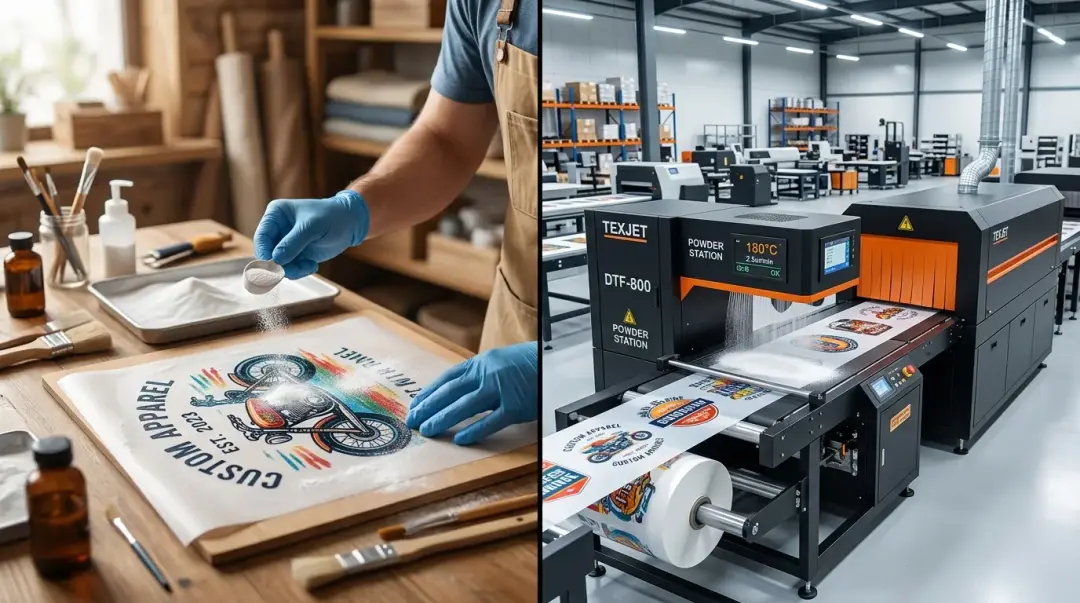
Direct-to-Film (DTF) printing has revolutionized garment decoration, but it brings a critical question for small shop owners: Do you actually need a DTF powder shaker? Many beginners are tempted by the convenience of automated systems, but a powder shaker is a significant capital investment. Understanding whether it is a necessary tool or an optional upgrade depends almost entirely on your daily production volume.
The Manual vs. Automated Reality
For shops producing under 20–30 transfers per day, manual powdering is a completely viable business strategy. The process—sprinkling TPU hot-melt adhesive powder over the wet film print, shaking off the excess by hand over a tray, and curing with a heat gun or flash dryer—requires minimal overhead. While it requires a bit of technique, it produces results that are functionally identical to machine-powdered transfers when done with care.
The Threshold: When Manual Becomes a Bottleneck
Once your daily output consistently grows past 30–50 transfers, the manual process transforms from a “craft” step into a significant production bottleneck. At this level, the hidden costs of manual labor become measurable through:
- Inconsistency: Variations in how operators apply powder can lead to spotty adhesion, resulting in more reprints and potential customer complaints.
- Labor Time: Manual powdering takes roughly 2–3 minutes per print. If you are doing 50 prints, that is over two hours spent on a task that could be automated.
- Workspace Contamination: Loose TPU powder is a fine, airborne irritant. Manual shaking inevitably releases particles into the air, which can eventually settle on your printer's delicate nozzles, leading to premature maintenance issues.
Investment Analysis: Is a Shaker Worth It?
An entry-level standalone powder shaker typically costs between $500 and $900. When combined with a small conveyor curing oven ($800–$1,500), you are looking at a total investment of $1,300 to $2,400. For a shop producing 50+ transfers per day, this equipment often pays for itself in reduced labor costs within just two to three months.
| Feature | Manual Powdering | Automated Shaker/Oven |
|---|---|---|
| Throughput | Low (<30/day) | High (50+/day) |
| Consistency | Operator dependent | High/Machine precise |
| Workspace | Risk of powder dust | Sealed/Cleaner environment |
| Investment | Zero (Starter tools) | Moderate ($1,500+) |
Key Decision Rules
Key Takeaway: If you are hand-powdering more than 30 prints per session and noticing adhesion inconsistencies, or spending more than an hour on the powdering step alone, a shaker is no longer an optional upgrade—it is an operational necessity.
Maintenance Considerations
Transitioning to an automated shaker doesn't just save time; it protects your equipment. Automated systems operate in a sealed chamber, which significantly reduces the amount of loose adhesive powder circulating in your print shop. Consistent, clean production environments are essential for maintaining the long-term health of your DTF printer's printheads.
Before purchasing, ensure your shop has the physical space to accommodate a shaker-oven bundle. Unlike manual trays, these units require dedicated floor or bench space and often have specific electrical requirements. Assess your current growth trend; if you expect to hit that 50-print threshold within the next quarter, early investment can prevent the inevitable production logjam.
Frequently Asked Questions
At what daily production volume should I consider investing in a DTF powder shaker?
Does manual DTF powdering affect print quality compared to using an automated shaker?
Why is loose TPU powder a concern for my DTF printer's maintenance?
How long does it typically take for an automated powder shaker and curing oven to pay for itself?
What should I evaluate before buying a DTF powder shaker and curing oven?
Comments
No comments yet. Be the first to share your thoughts!