
DTF vs. DTG Printing: Which Is Better for Your Shop?
Choosing between DTF vs. DTG printing? We compare production workflows, fabric compatibility, and cost to help you decide which is best for your apparel shop.
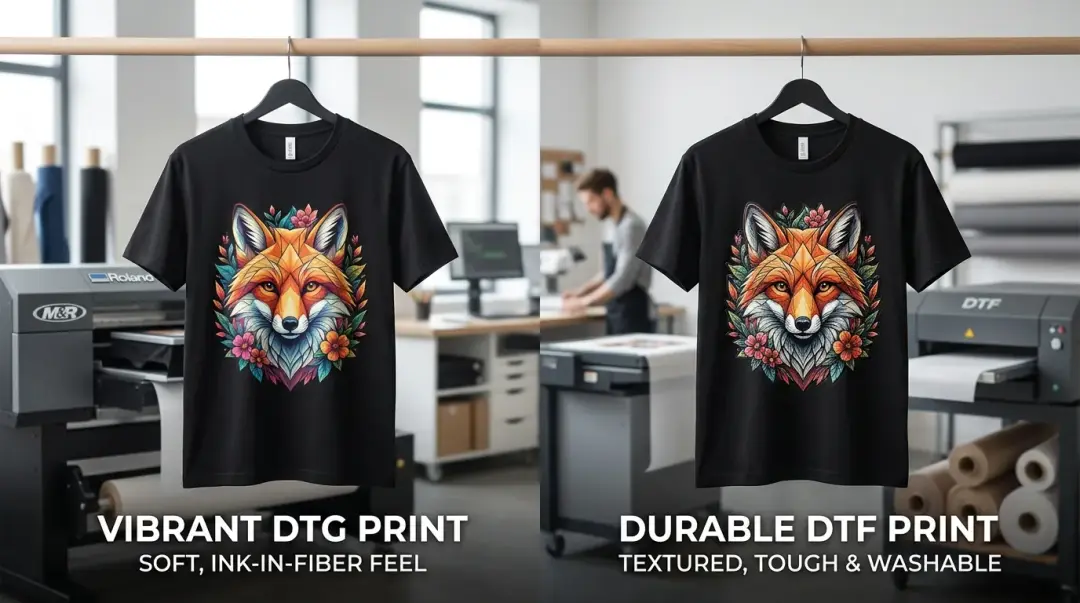
In the evolving world of digital apparel decoration, Direct-to-Garment (DTG) and Direct-to-Film (DTF) printing are the two most debated technologies. While both methods utilize inkjet printing technology, they serve vastly different operational needs, fabric capabilities, and financial models. Understanding the fundamental differences is crucial for any shop owner looking to optimize their production floor.
Understanding the Core Technologies
To determine the best fit for your shop, you must first distinguish how these systems interact with textile fibers. DTG printing applies ink directly into the fabric, requiring a pre-treatment process to ensure adhesion, particularly on dark garments. Conversely, DTF involves printing designs onto a specialized PET film, which is then coated with a TPU adhesive powder, cured, and heat-pressed onto the garment.
DTG: The Premium Hand-Feel Standard
DTG is celebrated for its ability to produce a near-invisible print on light-colored 100% cotton garments. Because the ink is jetted directly into the fibers, the resulting print offers a soft, breathable hand-feel that is often unmatched by other methods. It is the gold standard for high-end, retail-quality cotton apparel.
DTF: The Versatility and Cost Leader
DTF has revolutionized the industry by removing the barriers of fabric type. Because the print is a transfer layer rather than being integrated into the fiber, it can be applied to polyester, nylon, treated leather, and various blends without complex pre-treatment. The white underbase is printed on the film, ensuring consistent opacity regardless of the garment's color or material.
Comparison: DTG vs. DTF at a Glance
| Feature | DTG Printing | DTF Printing |
|---|---|---|
| Fabric Compatibility | Primarily Cotton | Almost any fabric |
| Hand Feel | Extremely soft/breathable | Flexible/lightweight layer |
| Pre-treatment | Required for all | Not required |
| Durability | 25–30 washes | 50+ washes |
| Ideal Use Case | High-end light cotton | Small-run, mixed-fabric |
Operational Efficiency and Cost Structure
When analyzing costs, DTG often faces higher overhead due to the necessity of garment pre-treatment and longer print times, especially when a white underbase is required for dark items. The time spent pre-treating, drying, and then printing significantly impacts shop throughput.
DTF thrives in high-efficiency, small-run environments. Since the transfer process is separate from the application process, shops can print large volumes of transfers ahead of time. This batch-production capability allows for faster turnaround times when customers demand custom, multi-fabric orders.
Key Takeaway: For shops focused on high-volume, premium, 100% cotton apparel, DTG remains king. For businesses prioritizing versatility, speed across multiple fabric types, and lower production costs, DTF is generally the superior investment.
Making the Choice for Your Shop
The decision ultimately rests on your target market:
- Choose DTG if: Your clientele demands the highest level of print softness, you work almost exclusively with light-colored cotton, and you have the operational space to manage the pre-treatment process.
- Choose DTF if: You need to decorate polyester, performance wear, or blends; you want to reduce production time; or you want to offer diverse, full-color designs without the headache of inconsistent white ink bases on dark fabrics.
Many successful shops now utilize a hybrid model, using DTG for specialized cotton-based retail runs and keeping a DTF system for daily operations, samples, and performance apparel. Balancing these two technologies can position your shop to handle virtually any customer request.
Frequently Asked Questions
What is the main difference between DTF and DTG printing technologies?
Which fabric types are best suited for DTF printing?
Does DTG printing offer better print quality than DTF?
Why is DTF considered more operationally efficient for small-run shops?
Is DTF more durable than DTG in terms of wash cycles?
Comments
No comments yet. Be the first to share your thoughts!